
By Staff Writers Amrita Gunasekaran, Amber Halvorsen, Ananya Rawlani & Sabrina Zeng
Content warning: discussion of sexual assault
The Cornell 7 case
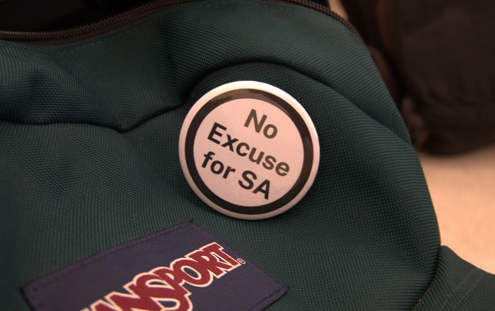
On the brisk morning of Friday, October 2, flocks of students donning black clothing arrived at MSJ. Leading this blackout effort was Senior Melody Gao, who had been up early that day, working with other leaders to create pins — each one with declarations such as “no excuse for SA” and “justice for Jane Doe”— that were later distributed to participating students. The demonstration followed the resurgence of a rape investigation at Cornell University, which drew national attention in mid-September after The Cornell Daily Sun published an article covering the case.
As the story spread across social media and news organizations, discussions about sexual assault and accountability reached MSJ. Gao and the other organizers wanted MSJ’s movement to go further than Instagram story reposts. “Having people do something in real life … is the first step to them actually taking some action because they have to do something in real life more than just post something,” Gao said.
The victim of the Cornell case, publicly known under the pseudonym Jane Doe, filed a lawsuit against Cornell University, the fraternity Chi Pi, her sorority Tri Delta, and others involved, for negligence, pushing the case to become a hot topic of controversy on the internet. MSJ students posted stories on social media, denouncing rape and sexual assault, and participated in online movements.
Gao talked about how Cornell’s actions, or lack thereof, protected rapists while refusing victims any support. “I wasn’t too surprised about [the sexual assault] happening or even the college’s response to it, because unfortunately it’s become really normalized, and a lot of higher institutions turn a blind eye to it,” Gao said.
Additionally, the flood of discourse about this case on the internet brought attention to the institutional process of reporting a case or frequent dismissal of sexual assault cases on college campuses. According to Anish Devasia from Safe and Sound Security, 80% to 95% of sexual assault cases go unreported on college campuses. “I think [the] Bay Area isn’t different from any other community in the way that it has a lot of situations of sexual assault … There have been cases in FUSD schools where teachers have been predatory towards students. It is something that still happens around the Bay Area, just as much as anywhere else,” Gao said. “Students should definitely pay attention to it and not feel like we’re in a safe area just because they don’t hear about it as much.”
FUSD’s sexual assault policy
FUSD’s official policy states that students who feel that they are being sexually harassed should immediately contact the principal, assistant principal, counselor, psychologist, nurse, any teacher or staff member, or Salvador Herrera Jr., Director of Student Support Services. FUSD defines sexual harassment as unwelcome advances, requests for sexual favors, and other verbal, visual, or physical conduct of a sexual nature made by someone from or in the educational setting.
“We also want to make sure that all parties involved, complainant and respondent, receive the appropriate support that they need, the fairness, and the confidentiality that they hold so dear to them,” Principal Amy Perez said. At the beginning of each school year, students are shown an educational video explaining what constitutes as sexual harassment and how to seek support. Furthermore, administration has posted mandatory sexual harassment awareness posters around campus, and provided support hotlines on the backs of student ID cards.
When a student or their friends tell an adult — including teachers, administrators, or Wellness Center Staff Member Jennifer Yen — about a sexual assault experience, an investigation is opened immediately. After ensuring the physical and emotional safety of the student, administration asks the student to retell their story, in any method they feel comfortable, calls in witnesses, speaks to respondents, and interviews all parties. The appropriate adults are then notified and therapeutic service options are provided.
Law enforcement would only be involved “where the law has been broken — not school rules, board policies, but the actual law,” Principal Amy Perez said. Law enforcement officers conduct a separate investigation, unless the student and their family declines their involvement. “[We take] these situations very, very seriously,” Perez said.
Sexual assault cases in the Bay Area
In 2025, there were 27 reported rape cases and 91 reported assault cases in the city of Fremont, including attempted rape and sexual battery.
The Bay Area has also seen various sexual harassment cases involving law enforcement in the last 20 years. In October 2024, a 17-year-old Sunnyvale high school student, identified as Jane Doe in a legal complaint, accused Marine recruiter Jorge Lara-Pedroza of raping her for nearly six hours at a recruiting center. The Marine Corps and Navy were given 6 months following the date of the complaint to investigate the case because the complaint was a tort claim.
More than 50 sexual abuse lawsuits involving Bay Area school districts emerged in the second half of 2022, including California School for the Deaf, Los Gatos-Saratoga Union High School District, and Redwood City School District.
In 2007, Matthew Shelton, a former Benicia elementary school teacher, was accused of inappropriately touching four students at Phillips Magnet Elementary School in Napa. Despite testimony from three students, a jury found him not guilty after just 20 minutes of discussion, and he was rehired six months later. Nearly two decades later in 2026, he faced similar allegations. Two former students testified again, telling KQED that educators who had once comforted her later defended Shelton in court, claiming the girls were lying. Students involved in the case have described lasting emotional and traumatic effects, including one student experiencing a lasting fear of male teachers following them until high school.
Importance of Sexual Assault Awareness at MSJ
When blackout leader Senior Megan Chu first heard of the Cornell rape case, she was struck with outrage rather than shock. Looking at the media and news in modern society, Chu felt that sexual assault was not taken seriously enough, given the gravity and frequency of the issue.
At school, Chu does not recall being taught enough about sexual assault. Instead, she went home, talked to her parents, and did her own research online. “Even in health class, yes, there [are] posters, but who’s gonna really look at a poster unless it’s being taught actively in class?” Junior Aarna Tyagi said.
Chu and the other protest leaders went into the blackout with a goal deeper than wearing the color black and attaching pins to clothing or backpacks. Their goal was to spread awareness and bring light to sexual assault. Though the blackout had widespread student participation, responses from the student body were not universally supportive. During the blackout, Chu noticed a student wearing a Cornell sweatshirt. Later in the day, Chu talked about the blackout with her classmates. “I’ve learned that a few freshmen were calling our movement [live action role-playing], and I honestly really thought that was messed up,” Chu said.
The disconnect at MSJ points to a potential gap in sexual assault awareness: if students struggle to connect with cases like Cornell 7, how prepared are they to recognize and address sexual assault within their own community? Shortly after the Cornell case gained attention and before the blackout, a DECA member facetiously referenced the Cornell 7 in a speech on stage in C120. Dhivya Venkat, an officer responsible for overseeing DECA workshops, says the audience had erupted in gasps at what the presenter had said. “Sexual assault is a human rights violation. In this particular case … it happened to a young woman, but sexual assault is something that could happen to anyone,” Venkat said. “I think the MSJ community needs to realize that no matter where something happened, it can happen to us, and we have to do whatever we can to prevent it from happening to us or anybody else in the world.”
The Steps MSJ Follows When an Incident is Reported
- The student or friends of the student report the alleged harassment or assault to the principal, assistant principals, teachers, counselors, other staff members, or FUSD Director of Student Support Services Sal Herrera Jr., or ll out the Online Sexual Harassment Complaint Form.
- The alleged victim is called into the office to confirm safety and retell their story in a preferred method.
- Compliance officer Hillary Harrell is contacted to decide if the case is a Title IX violation.
- If it is a Title IX violation, FUSD follows a different investigative process involving the distinct. If not, witnesses are called in and questioned with standardized questions listed by Officer Harrell.
- Anyone involved, such as the alleged victim, perpetrator(s), and potential witnesses are questioned separately.
- Parents or guardians, as well as any relevant adults are informed.
- Students are offered therapeutic services and provided “safe” teachers for the student to go to, identified by the admin team.
- Digital evidence is checked from all parties, keeping in mind that evidence may be digitally altered.
- If the law has been broken, the student and their family have the option to get law enforcement involved. If the incident occurred between a faculty member and a student, law enforcement will be involved and is not optional.
- If law enforcement is involved, they will conduct a separate investigation. If they are not involved, only the school will have an investigation.
- The verdict is reached, and administration may provide disciplinary action or make protective adjustments accordingly.
Be the first to comment on "Bay Area sexual assault culture and awareness"