
By Staff Writers Varun Madhavan & Joseph Miao
Founders Lalit Bachu and Rohan Babbellapati formed Bin to Better on the belief against waste as just trash, rather than opportunity. A statistic that inspired this was how each year, nearly 330 million tennis balls are manufactured, almost all of which end up in landfills across the country where they take over 400 years to decompose. To combat this, the organization focuses on repurposing everyday items, like used tennis balls, that would otherwise remain in landfills for centuries. “We just don’t want [useful items] to end up in trash and landfills only because they don’t serve their original purpose,” president Pradyun Kanuparthi said.
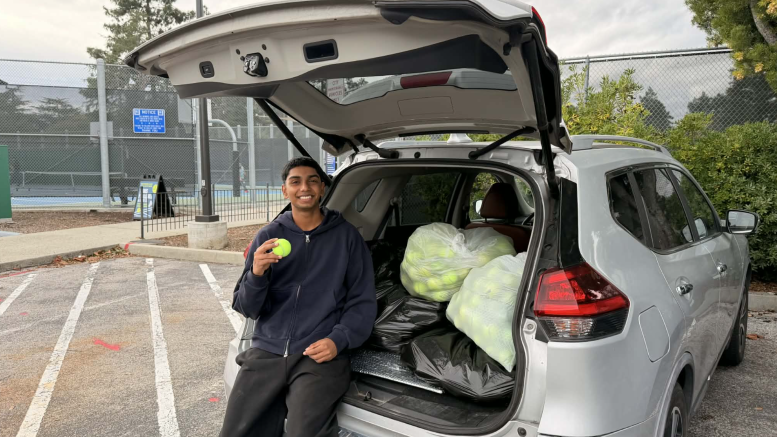
Bin to Better focuses on select primary projects aimed at improving their local communities facilities. Their flagship initiative is the Bounce Back Project, which collects used tennis balls from tennis clubs from across the Bay Area and upcycles them. Student volunteers redistribute these second-hand balls to schools, nearby animal shelters, and assisted living centers, demonstrating the meaningful impact of their efforts.
“The most notable accomplishment we’ve had so far [is when] we’ve collected a total of 25,025 tennis balls,” outreach officer Harmonie Lee said. “and [we’ve] collaborated with over 30 dog parks, 42 animal shelters, 28 academies and athletic clubs, 10 colleges, and 30 schools across the Bay Area.” In classrooms, tennis balls are placed on chair legs to reduce noise. Animal shelters have utilized tennis balls as enrichment toys for pets. Bin to Better aimed to illustrate how even a small shift in perspective can produce a measurable impact.
This nonprofit organization also expands its reach through other collective initiatives, ultimately furthering the initial vision of sustainability in local communities. Its Tech to Treasure program addresses the growing issue of electronic waste by collecting unused devices from drives and transforming them into educational tools. Students who attend receive a valuable opportunity to explore the intricate, inner workings of electronics through interactive workshops held by officers before collaboratively responsibly recycling all parts through several certified e-waste programs. Bin to Better also hopes to soon launch Eco-Blox, a project that will repurpose non-recyclable plastic waste, from bottles to casings, into durable building blocks.
Although Bin to Better stemmed from a simple vision of recycling tennis balls, they have evolved into a broader movement centered on sustainability via reusability. “We want to expand our organization through chapters around the country,” marketing officer William Lam said. Bin to Better hopes to extend their idea of an environmentally-conscious vision nationally, but their mission will always stay rooted in the same belief that even the smallest intentional actions can proliferate into lasting impacts.
Be the first to comment on "Bin to Better turns used tennis balls into community resources through their upcycling initiative"