
By Staff Writers Alex Duan, Veer Mahajan & Matthew Zhang
In October 2025, Department of Homeland Security Secretary (DHS) Kristi Noem’s statement that Immigration and Customs Enforcement (ICE) “will be all over” Santa Clara, the host for Super Bowl LX, sparked outrage in the sports community.
The threat of ICE presence created public backlash that included protests around Levi’s Stadium, social media campaigns, and even statements from members of Congress. “I want every person in Santa Clara, residents, workers, business owners, and visitors, to feel safe celebrating with us,” Santa Clara Mayor Lisa M. Gillmor said during a press conference about ICE’s presence at the Super Bowl.
Trump’s immigration crackdown comes at a time when the US is poised to host large sporting events, including the FIFA World Cup and the 2028 Olympics. Not only do these events bring together sports fans from across the world, but they also foster tourism, cultural exchange, and economic growth, making them significant indicators of national success. Introducing ICE creates a tense atmosphere full of fear and apprehension regarding raids and deportations, for immigrants both living in and visiting the US, heavily damaging the typical enjoyment and economic gain. The presence or potential presence of ICE can threaten these events in multiple ways: economically, psychologically, and diplomatically. It discourages immigrant and international participation, generates anxiety about documentation checks or raids, and creates a perception of hostility among host countries.
This fear of raids is not unfounded. Throughout the 21st century, ICE has carried out millions of deportations. Following a budget increase from $10 billion to $29 billion under the One Big Beautiful Bill Act, however, ICE has now expanded from searching border zones to community areas and the general public, and even at a raid on a child’s birthday party. With the perception that no setting is off-limits, the mere suggestion of ICE presence at a sporting event carries significant weight.
ICE reflects a pattern of applying political pressure to non-political organizations like the National Football League (NFL). The NFL’s decision to have Bad Bunny, a vocally anti-Trump artist, headline the halftime show directly opposes the president’s political messaging. In response to this, the Trump administration suggested sending in ICE, likely to assert federal authority and remind the organizers that large events do not prevent immigration enforcement priorities. ICE has a history of increasing raids in cities like Chicago and New York after local officials limited cooperation with federal immigration authorities; in Chicago, a judge signed an order in October 2025 barring ICE from arresting people at courthouses, resulting in an immigration crackdown, according to the Chicago Associated Press. This demonstrates how the tensions between ICE and local officials are increasing. Rather than following ICE’s mission statement of “protecting America from cross-border crime and illegal immigration,” the Trump administration uses ICE as a private militia to exert government influence on sporting events at home and abroad.
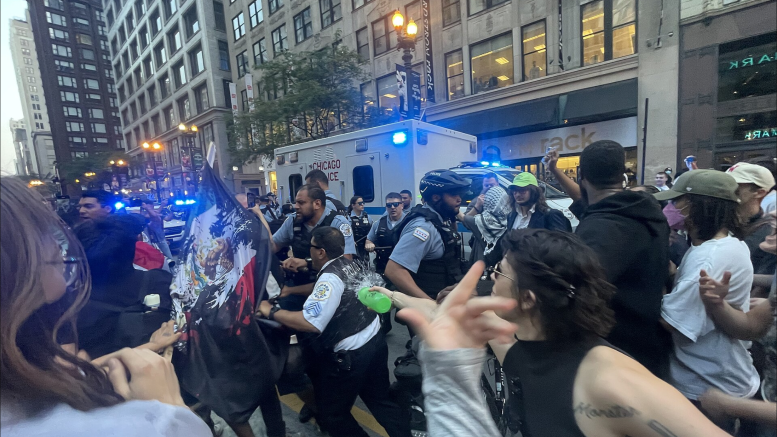
Because of ICE’s controversial actions, there has been strong backlash from protesters across nations. During the Super Bowl, more than 15,000 participants marched around the perimeter of Levi’s Stadium to protest Secretary Noem’s claim of ICE activity at the event. In Milan, Italy, at the Winter Olympics, reports of ICE agents sparked similar opposition, with local residents taking to the streets to protest their presence. The Olympics are a “moment of celebration, unity and economic opportunity, not fear, polarization and violence,” Rep. Ro Khanna said in a press release with 21 other members of Congress. Although the DHS presence was later revealed to be a standard diplomatic security package, Trump’s consistent use of ICE as a private army to enforce his own will on sporting events has shaken the Italians up. “This is a militia that kills,” Milan Mayor Giuseppe Sala said to local media.
Sports have always been a medium for bridging cultures and celebrating differences through the thrill of the games. Maintaining the integrity of sports as spaces of unity requires transparency between organizers, athletes, and the audience, in addition to clear boundaries between immigration enforcement and public events, neither of which has been respected by the Trump administration. When political whims and demands endanger and even dismantle long-held traditions, it is incumbent on every fan to take back the integrity and enjoyment of sports. Change can be realized through peaceful protests and social media advocacy, necessary actions to counter organizational corruption. Rejecting the division and fear perpetuated by Trump’s administration is a vital step towards asserting a clear truth: sports must not be a place for the federal government to forcefully impose a conservative agenda.
Be the first to comment on "SportsxOpinion: ICE agents at Winter Olympics is a red flag of totalitarianism"